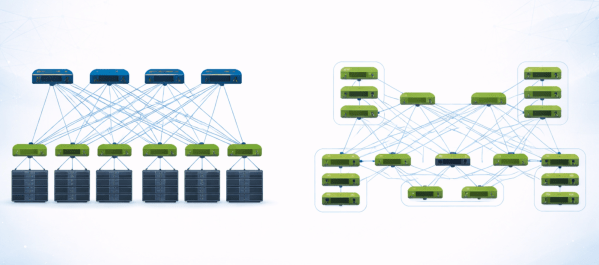
Choosing Between Leaf-Spine and Butterfly Fabrics in Modern Data Centers

Leaf-spine is the default. But it’s not always the right answer.

In modern data center networking, the leaf-spine Clos fabric has become the default architecture for good reason. It’s predictable, scalable, and aligns well with familiar Ethernet-based designs and operational models. But as workloads evolve, particularly with the rise of large-scale AI and distributed systems, alternative topologies like butterfly fabrics are getting renewed attention. Both architectures aim to deliver high bandwidth, low latency, and scale, but they approach the problem in fundamentally different ways.

Continue reading “Choosing Between Leaf-Spine and Butterfly Fabrics in Modern Data Centers”

Designing the Modern Data Center Network for AI Workloads

The fastest GPU is only as fast as the slowest packet.

For years, data center design has been driven by compute density, virtualization efficiency, and east-west traffic patterns dominated by many small flows. That model breaks down entirely when you step into AI training environments. What you’re building now isn’t just a traditional data center. It’s a distributed, synchronized compute system where the network is a first-class component of performance.

Continue reading “Designing the Modern Data Center Network for AI Workloads”

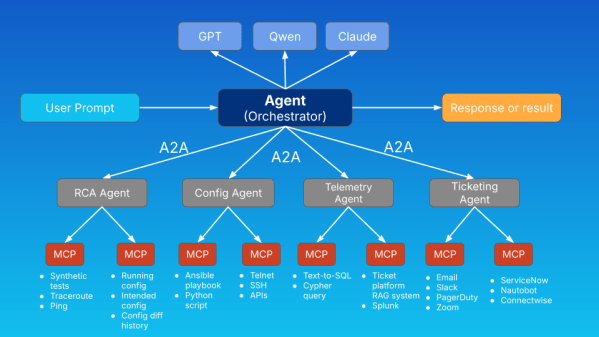
Understanding the A2A Protocol for Agentic AI in Network Operations

Over the last year, we’ve seen explosive interest in agentic AI systems built with LLM-powered components that can reason, plan, call tools, and coordinate with other agents. But if you’ve actually tried to build a multi-agent workflow, whether for network automation, observability, or network incident response, you’ve probably run into one glaring problem – all agents don’t speak the same language.

Continue reading “Understanding the A2A Protocol for Agentic AI in Network Operations”

Blog at WordPress.com.

Up ↑